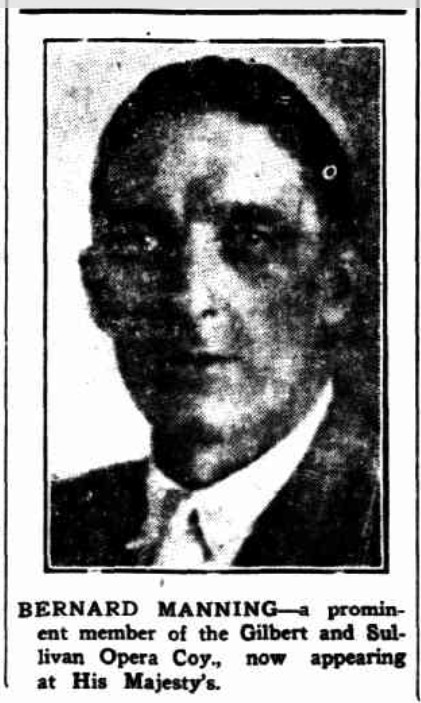
Our Founder – Bernard Manning

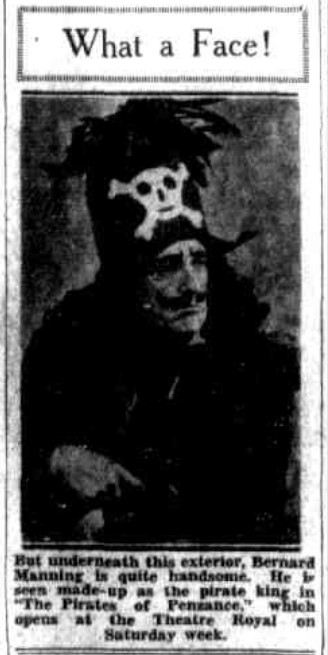
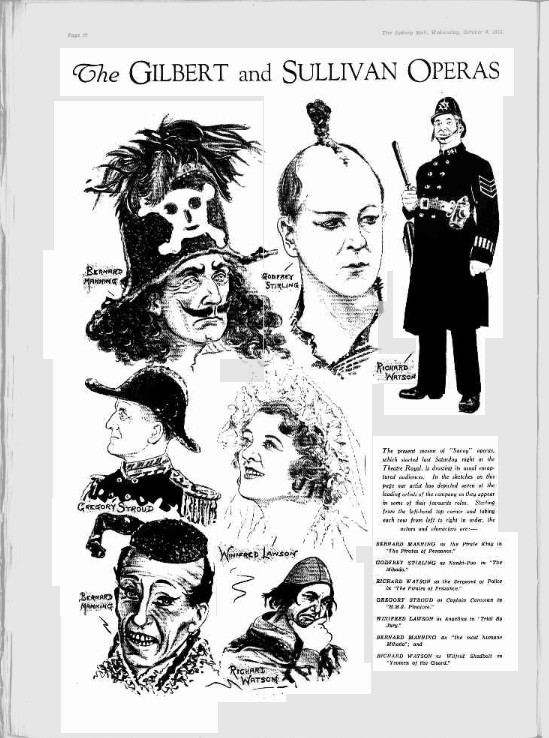
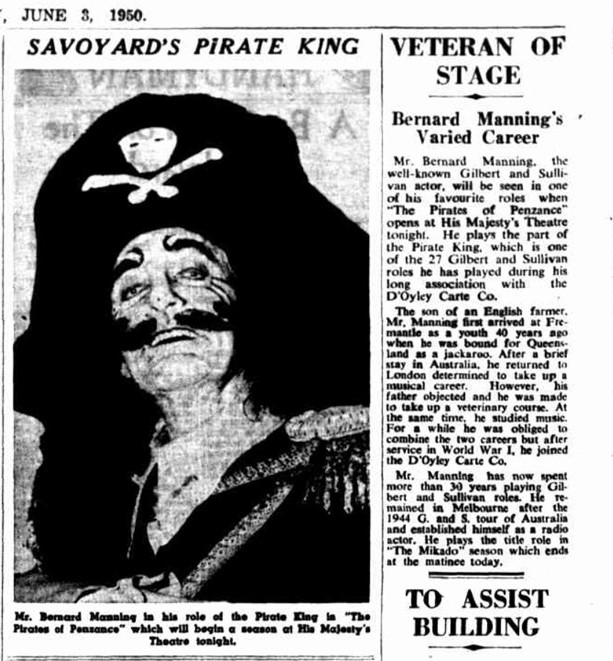
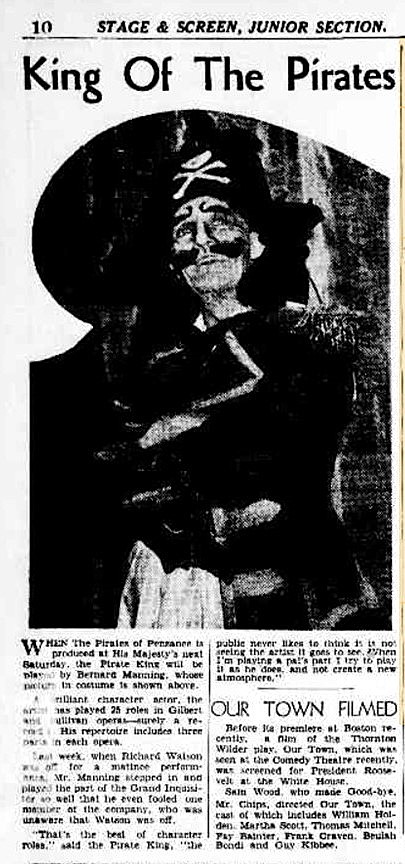
Bernard Manning as The Pirate King, D'Oyly Carte Opera Company
Bernard Manning as The Pirate King

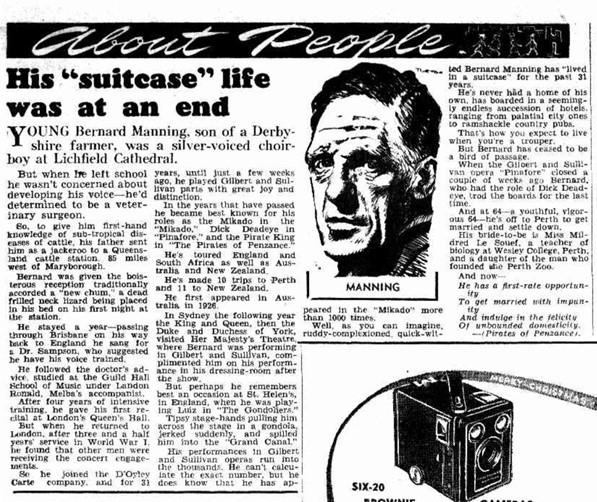
Bernard Manning was born on the 19 October 1886 in Derbyshire, England, the youngest son of Robert Manning-Smith and his wife. Bernard was brought up on a family farm in Kedleston which his ancestors had held since 1443. Though his elder brother inherited the farm, he still had fond memories of his time there, “I’m the youngest of the Mannings. In my youth I tilled the land. No life like it!” 

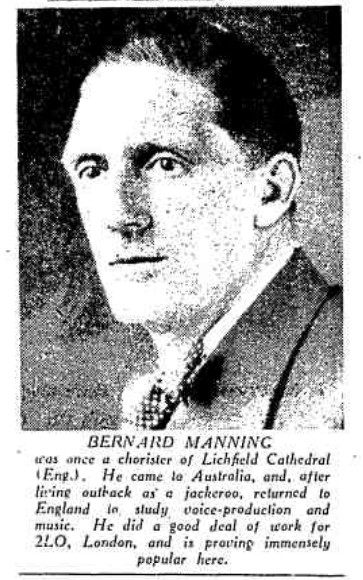
As a boy he sang in the choir at Lichfield Cathedral in Staffordshire before moving for a short spell due to ill health to Australia, “When I was twenty-one I came out to Queensland and spent a year as a jackaroo in Maryborough on a station. I had indifferent lungs then, but that year gave me health; and I went back home and became a singer.”
While living in Australia, he continued his vocal training as a tenor at the Brisbane Anglican Cathedral. 

His health improved, Bernard returned to England and continued his musical studies at the prestigious Guildhall School of Music in London.
Though his voice encompassed a wide range (low D to top A), his teacher, Sir Landon Ronald, (who famously collaborated with Dame Nellie Melba as a conductor and accompanist), insisted on Manning singing bass. “So I did, and within three months carried off the Guildhall School of Music prize for BASSO singing!” Bernard won the Schubert scholarship two years in succession and recalled that the first time was with, “The Wanderer”, and the second with “The Erl-King.

Bernard went on to win six prizes and in addition to continuing to study oratorio, began appearing on the concert stages, including at Albert Hall and London’s Queen’s Hall (sadly destroyed during the Blitz in WWII).

Rather than relying on his voice for a living however, Bernard was encouraged by his father, a farmer, to study medicine, qualifying as a veterinarian, “being the son of very commonsense people, I wasn’t taking any chances, I “double timed” my musical studies with medicine, and became a veterinary surgeon.”

Despite his busy schedule, Bernard found time to play soccer football for Derby County, and enjoyed golf, cricket, tennis, and swimming.

When WWI was declared (1914 – 1918), 28-year-old Bernard enlisted and fought in France with the London Scottish (regiment), where he suffered from a poison gas attack but was otherwise uninjured. “I ‘wore a kilt, ye ken’ for three years and eight months with the London Scottish in the war.”
Manning received a Distinguished Conduct Medal (DCM) for his services in World War I.

Bernard Manning - 1914 - Postcard - London Scottish Regiment
Bernard Manning - 1914 - London Scottish (regiment)

After returning from the frontline in France, Bernard joined the D’Oyly Carte Opera Company in 1919 aged 33 and rose to the ranks of principal baritone in May 1920. “Though one sticks to tradition a great deal, (Rupert) D’Oyly Carte would not let me watch other artists playing the roles I was cast for. “Your personality demands your own reading.’ He’d say, ‘and if you go far wrong, I’ll correct you.” During this time Manning’s major credits included:

Counsel to the Plaintiff in Trial by Jury (June 1921 – March 1923)
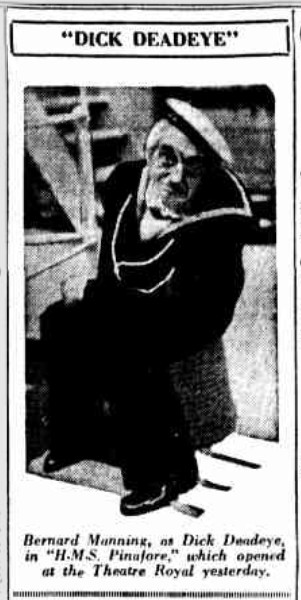
Dick Deadeye in H.M.S. Pinafore (July 1923 – June 1925)
The Pirate King in The Pirates of Penzance (June 1921 – June 1923)
The Earl of Mountararat in Iolanthe (July 1923 – June 1924)
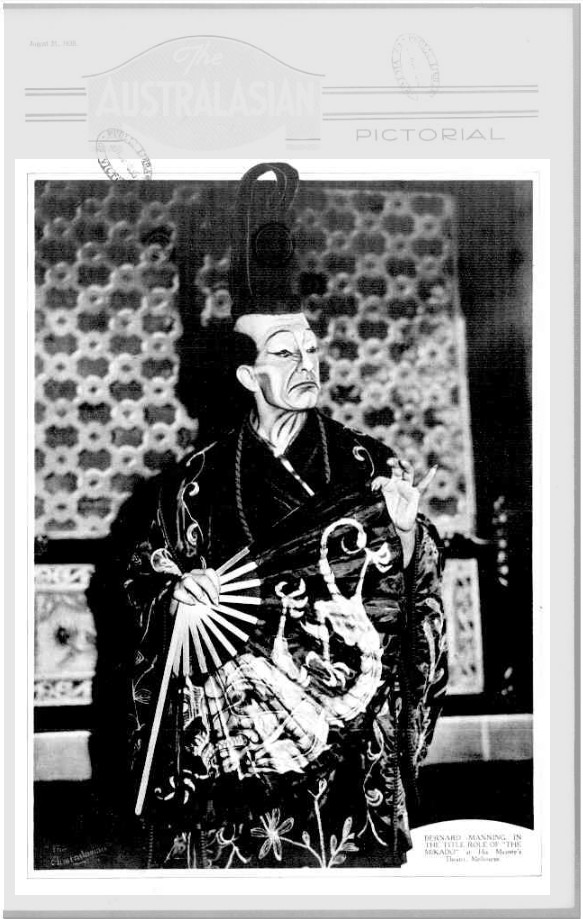
Pish-Tush (May 1920 – May 1921) and the Mikado (July 1922 – June 1925) in The Mikado
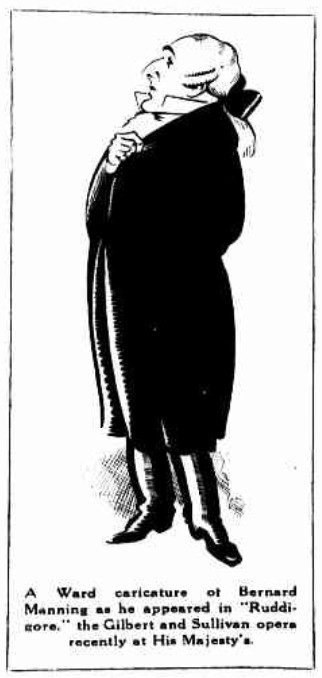
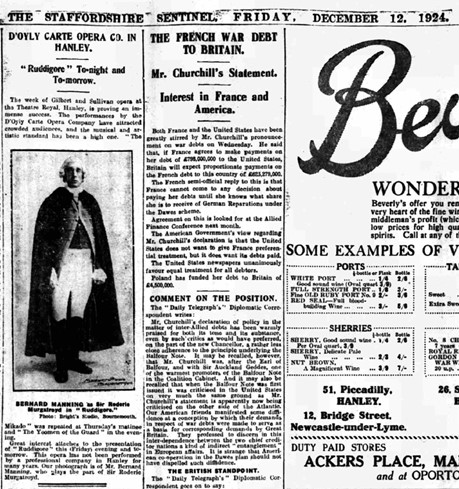
Sir Roderick Murgatroyd in Ruddigore (July 1924 – June 1925)
The Lieutenant of the Tower (May 1920 – May 1921) and Sergeant Meryll (June 1921 – June 1925) in The Yeomen of the Guard
Annibale (May 1920), Luiz (May 1920 – November 1922), and Giuseppe (December 1922 – June 1924) in The Gondoliers
Sergeant Bouncer in Cox and Box (July 1924 – June 1925)

His six years with the D’Oyly Carte Opera Company provided Manning with a solid base and first hand experience in the Gilbert & Sullivan operettas which subsequently informed his performances throughout his career.

Bernard Manning as Sergeant Merryl in The Yeoman of the Guard
Bernard Manning as Dick Deadeye in HMS Pinafore
"Perhaps my most successful role is that of Dick Deadeye in (HMS) Pinafore." - Bernard Manning, 1932

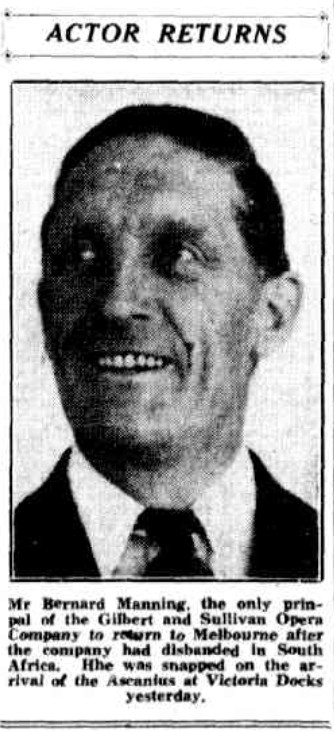
Bernard left the D’Oyly Carte Opera Company in June 1925 when he was 39, and travelled to Australia, accepting a contract with the J. C. Williamson Company and performing with the troupe for 25 years.

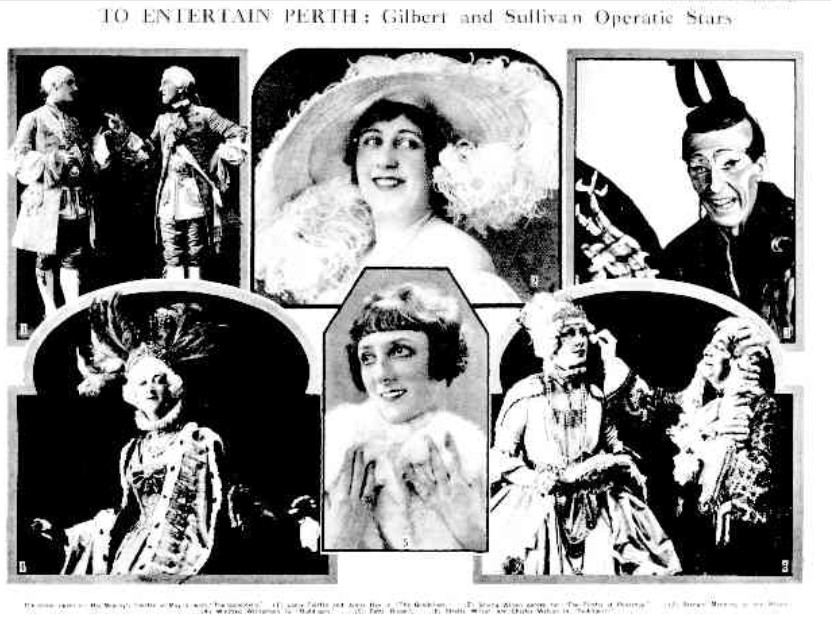
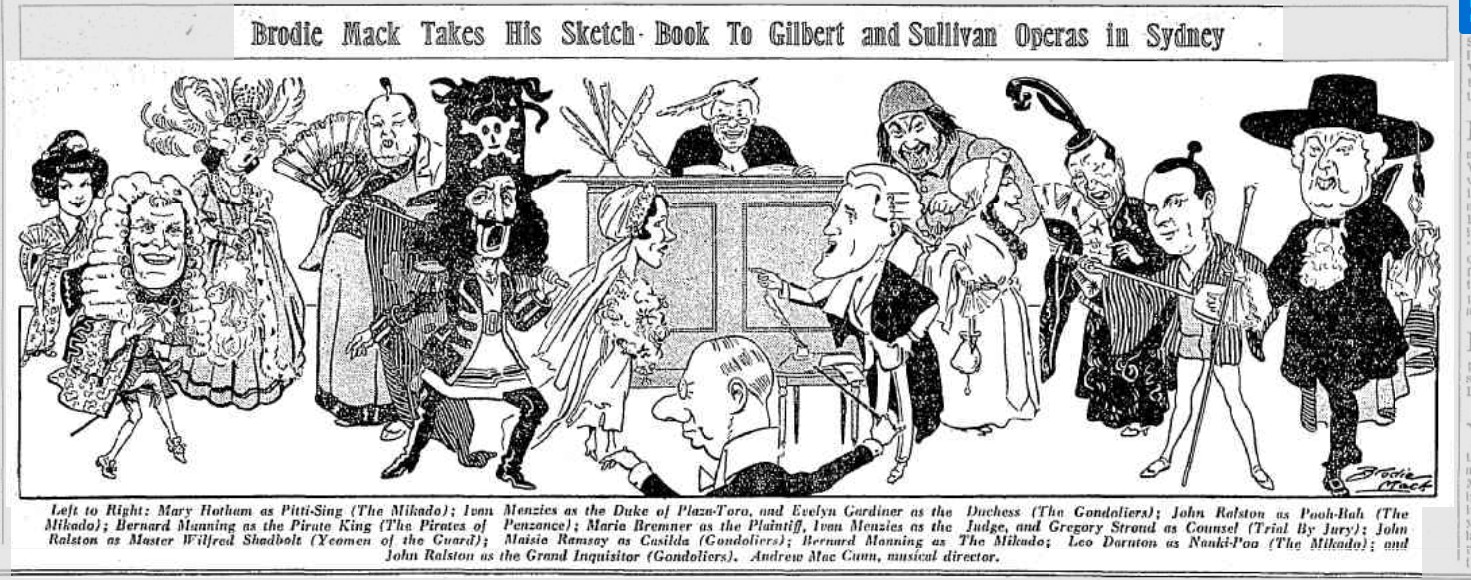
Of his major and recurring credits, he was Sir Roderick in the Australian premier of Ruddigore in Sydney in August 1927, and also appeared in Trial by Jury, H.M.S. Pinafore (as Dick Deadeye), The Pirates of Penzance (as the Pirate King), Patience (as Colonel Calverley), Iolanthe, Princess Ida, The Mikado (as the Mikado), The Yeomen of the Guard, and Cox and Box (as Bouncer).

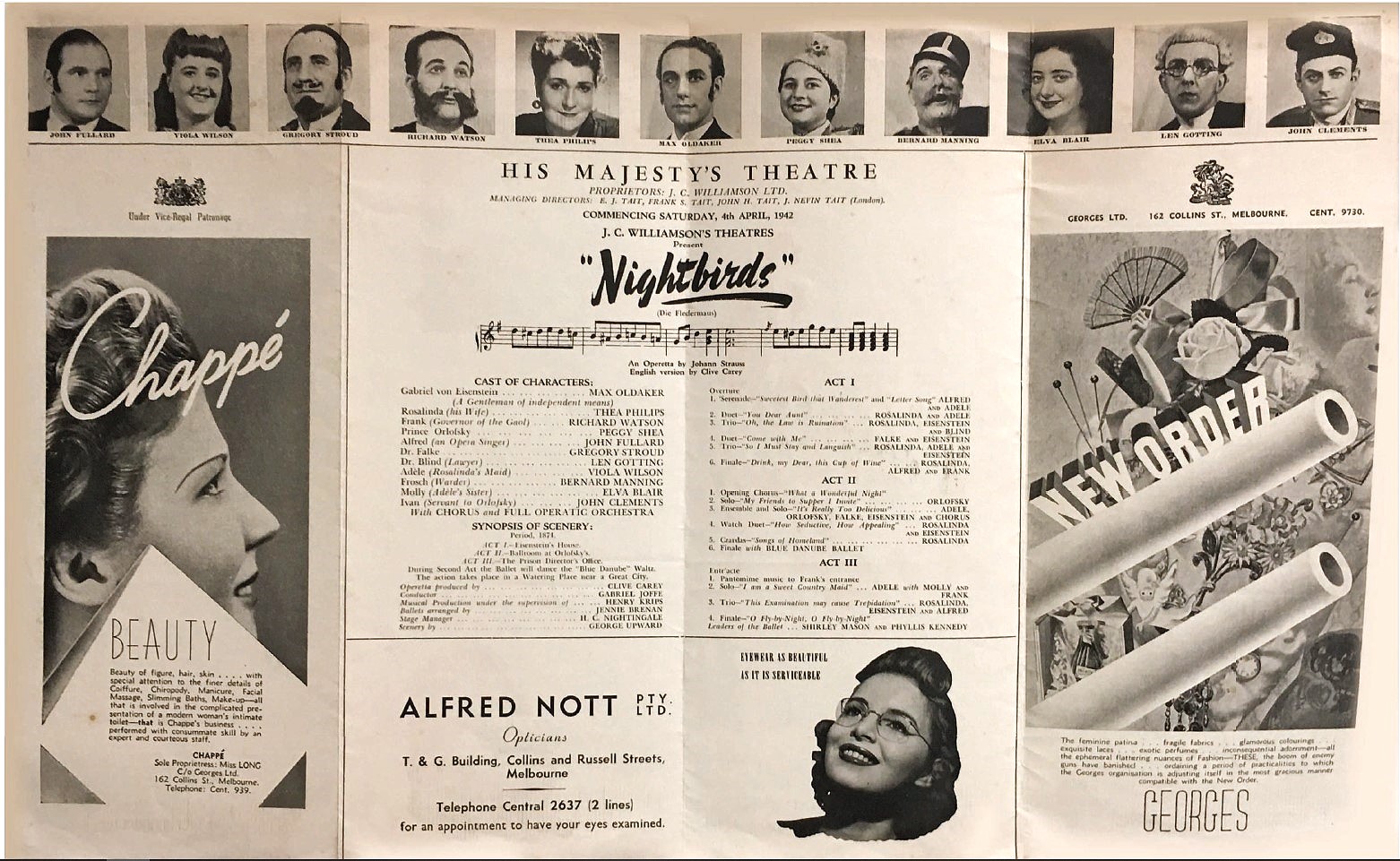
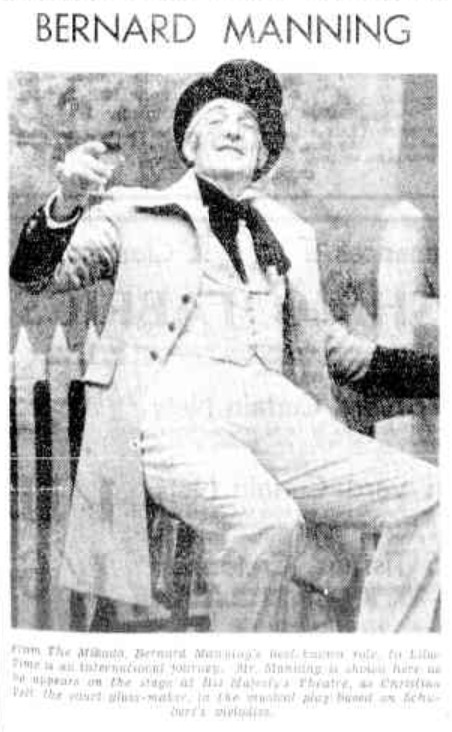
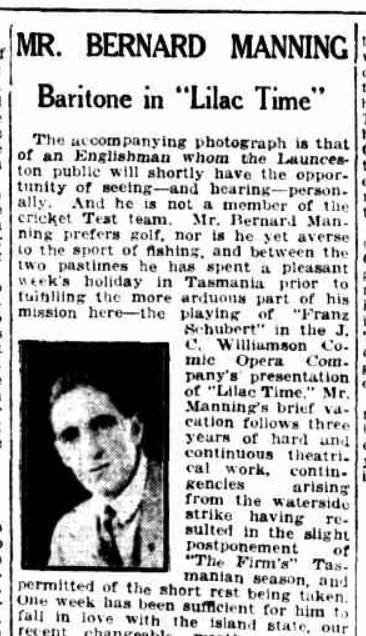
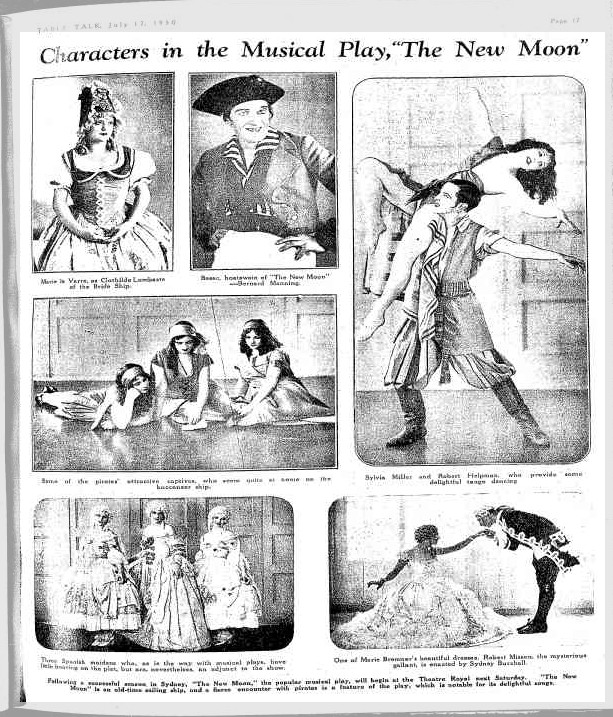
Bernard also starred in popular non-G&S operettas such as Nightbirds (an English language version of Die Fledermaus by Johann Strauss);  Franz Lehar’s The Merry Widow; Sigmund Romberg’s  The New Moon and The Desert Song; and Lilac Time by Franz Schubert amongst many others. He toured extensively throughout Australia, New Zealand and South Africa between 1926 and 1949.

During the 1927 Royal Visit of Australia and New Zealand by the Duke and Duchess of York (later King George VI and Queen Elizabeth the Queen Mother), Bernard met with and was complimented by their Majesties for his performance as Dick Deadeye in HMS Pinafore. 
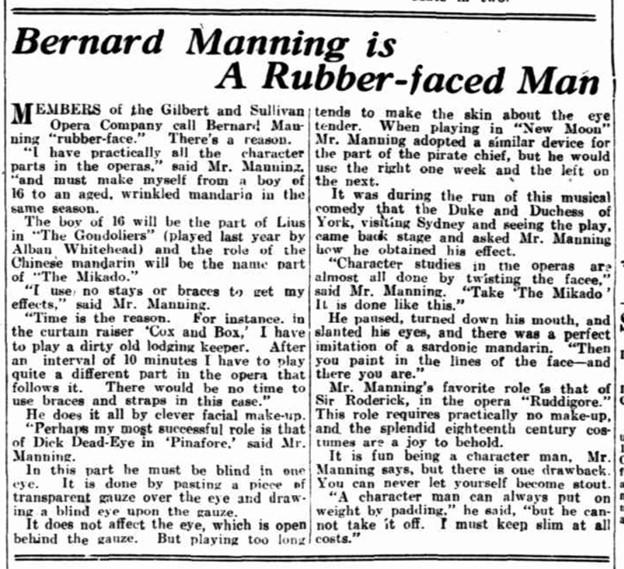
“I think one of the proudest moments of my life,” he says, “was when after a Command Performance, the Duke and Duchess of York came around to my dressing-room and said: “We simply can’t leave until you show us how you fix your eye.” It isn’t often in life that one has an opportunity to give the King’s son a lesson in make-up!”
He explained to them, “By a piece of gauze bandage dyed the color of flesh and fastened over the eye with spirit gum, with one black line for eyelashes.” Bernard commented the advantage being that, though apparently blind, he could see through the gauze.

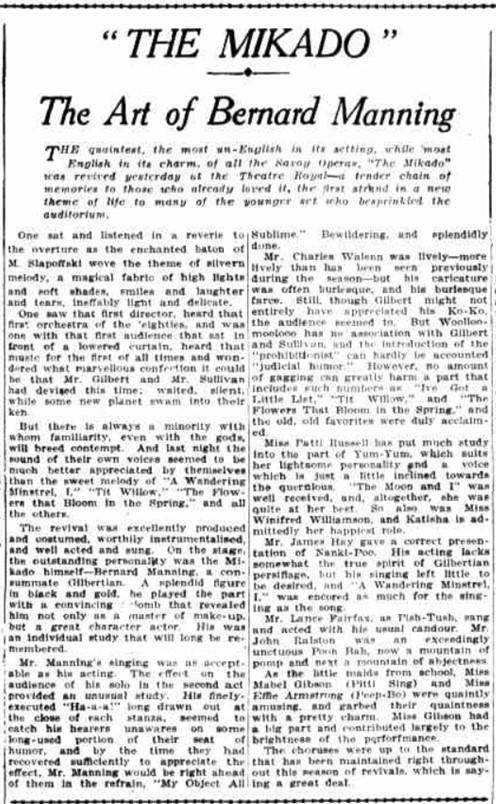
Over the course of his musical career, Bernard Manning’s performances in the Gilbert & Sullivan operettas ran into the thousands. Manning himself asserted that he had, “appeared in The Mikado more than 1000 times.”

From The Art of Bernard Manning, an article in Truth NSW newspaper, Feb 1927 “On the stage, the outstanding personality was the Mikado himself – Bernard Manning, a consummate Gilbertian. A splendid figure in black and gold, he played the part with aplomb that revealed him not only as a master of make-up, but a great character actor. His was an individual study that will be long remembered.” 

Manning’s favourite role was that of Sir Roderick in Ruddigore. Frequently cast in character roles often requiring make-up effects had gained him the moniker as “a rubber-faced man” from his cast members, however the role of Sir Roderick required practically no make-up, and had splendid 18th century costumes. 
Manning also made it a practice to visit the law courts at all places when on tour to study characters, particularly in roles such as The Judge and Counsel in Trial by Jury and the Grand Inquisitor in The Gondoliers.

See the full directory of Bernard Manning’s Australian performances and credits. 

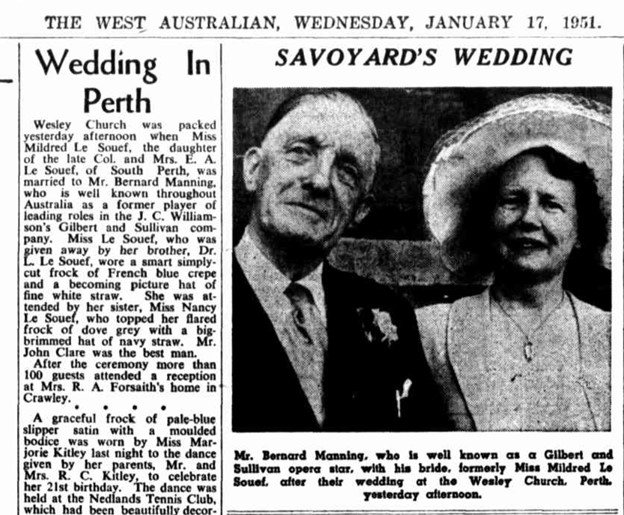
Bernard Manning & Mildred Le Souef married at Wesley Church, Perth, Western Australia

Manning broadened his reach as performer after 1944, appearing on regular radio broadcasts on 3AR and 3LO Melbourne, and 5CL Adelaide, in addition to singing with the Columbia Gramaphone Company.

He also added to his hobbies by playing the piano and he loved to read, enjoying the plays of WS Gilbert, “They are far too little known, but, together with the books of the operas, they are a good literary study. I love ‘Fogarty’s Fair’ (better known as Foggerty’s Fairy – editor). Among modern novelists I prize John Buchan and Galsworthy, and read everything that I can get of theirs.”

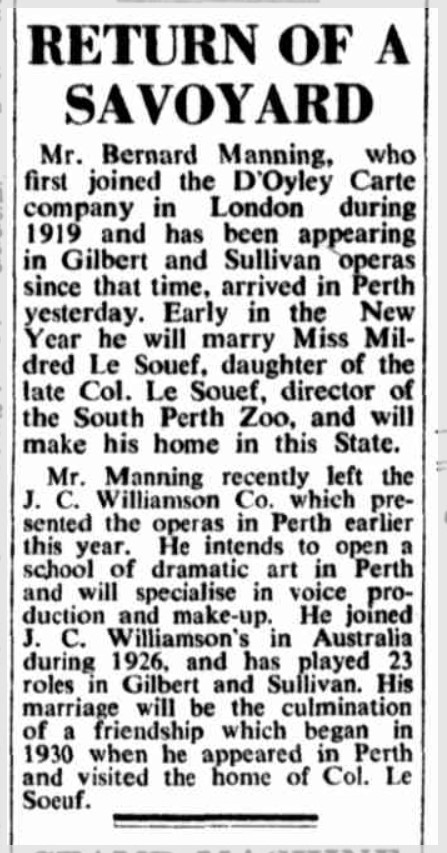
Bernard Manning retired professionally aged 64 in November 1950 with his final performances in Sydney. He then moved to Perth, where he married Mildred Hagenauer Le Souef in January 1951. Mildred was a biology teacher at Wesley College and daughter of zoologist E. A. Le Souef. His marriage to Mildred was the culmination of a friendship which began in 1930, when Manning visited Col. Le Souef at his home in South Perth.

Once settled in Perth, Manning set about the formation of a Gilbert and Sullivan Society for the benefit of the many enthusiasts in the city.

The Gilbert & Sullivan Society of WA was founded on 27 April 1951, with Manning elected President, supported by fellow JC Williamson alum and soprano Marie Bremner, and journalist and publicist William Beecham (also known at that time as Bill Beecham / Bill Wells) as Co Vice-Presidents.
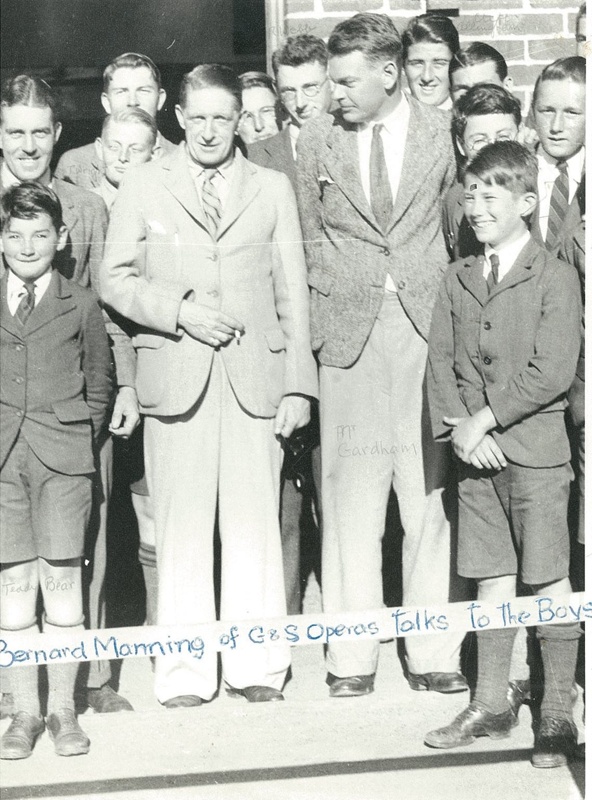
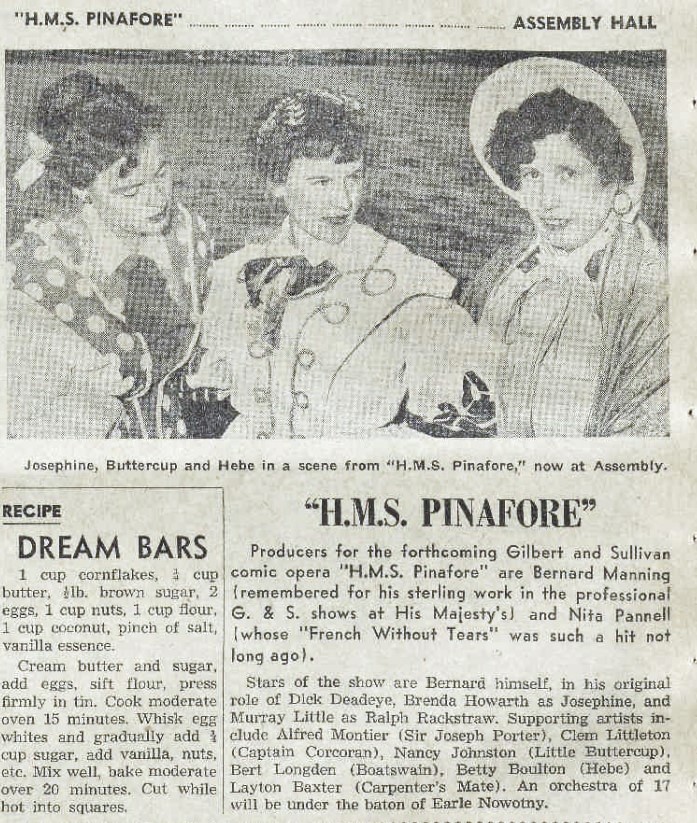
The Society’s first production was HMS Pinafore in 1953 at the Assembly Hall, co-produced by theatre director and actress Nita Pannell and Manning, who also played the role of Dick Deadeye.
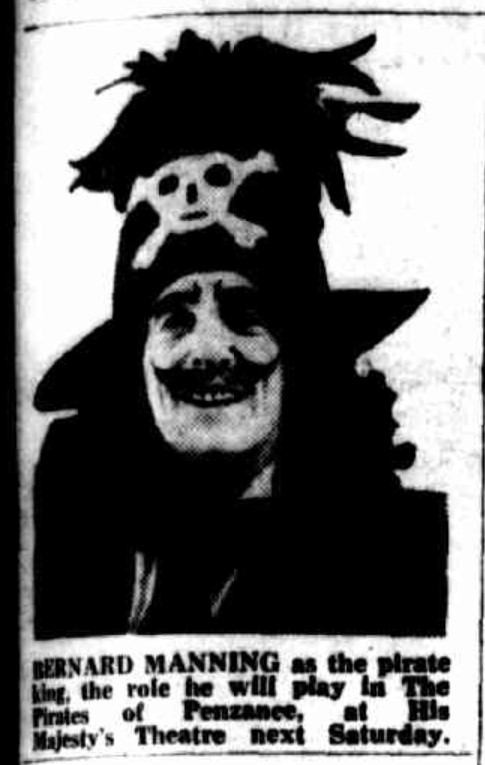
Manning then followed up by producing The Pirates of Penzance (1953 – His Majesty’s Theatre) which he also appeared in; he directed and appeared in The Gondoliers (1954 – His Majesty’s Theatre); directed and appeared in The Mikado (1954 – His Majesty’s Theatre); directed Trial by Jury & HMS Pinafore (1956 – His Majesty’s Theatre); and The Mikado (1958 – Capitol Theatre); and finally directed and appeared in Cox and Box & The Pirates of Penzance (1959 – Capitol Theatre).

After a long, illustrious career and life, Bernard Manning passed away at Royal Perth Hospital on 5 May 1961 at the age of 75.

Information, newspaper images and articles, and certain text courtesy of:
The Gilbert & Sullivan Archive, Wikipedia, The British Newspaper Archive, 
Trove – The National Library of Australia, The Australian Dictionary of Biography,
The State Library of WA and
HAT – History of Australian Theatre Archive., Picture Ipswich.

Additional images from the archives of the Gilbert & Sullivan Society of Western Australia.